How Do You Start Exercising Again After an Injury?
The safest way to start exercising again after an injury is usually to return gradually. Begin with movement and exercise that you can comfortably manage, rebuild strength and mobility, and progressively increase the difficulty as your body and confidence improve. Trying to jump straight back to where you were before the injury can be too much, too soon.
Recovering from an injury can be frustrating.
There’s often a point where the worst has passed and you feel ready to start doing more – but you’re not quite sure what you’re allowed to do.
Should you exercise?
Should you wait?
What if you hurt yourself again?
And how do you know when you’re ready to return to the gym, running, sport or whatever you enjoyed before?
At The Hive in Bideford, this is exactly where exercise and injury rehabilitation comes in.
Rather than going from “injured” straight back to normal exercise, rehabilitation provides a bridge between the two.
When Can You Start Exercising After an Injury?
There’s no universal timetable.
A minor muscle strain and a broken bone clearly aren’t the same, and even two people with apparently similar injuries may recover at different rates.
The appropriate time to return to exercise depends on things such as:
-
The type of injury
-
Its severity
-
How long ago it happened
-
Pain and swelling
-
Your current movement
-
Your strength
-
The activity you want to return to
-
Advice you’ve received from relevant healthcare professionals
For many musculoskeletal injuries, gentle movement can begin before you’ve returned to 100%.
But the type and amount of movement need to be appropriate for the injury and stage of recovery.
Why Is It Important to Return Gradually?
Imagine you normally run three times a week.
Then an injury means you don’t run for two months.
Even once the injury has improved, you’ve still had two months without your normal training.
Going straight back to the distance, speed and frequency you were doing before assumes your body is ready for exactly the same workload.
A gradual return allows you to rebuild your capacity.
The same principle applies whether you’re returning to:
-
Running
-
The gym
-
Football or rugby
-
Cycling
-
Gardening
-
Physical work
-
Walking longer distances
-
Group exercise classes
Your first session back doesn’t need to prove that you’ve recovered.
It’s simply the next stage of recovery.
Step 1: Regain Comfortable Movement
Before worrying about heavy weights or intense workouts, start with movement.
Depending on your injury, this might involve gentle mobility exercises, walking or movements that reproduce some of the actions you need in everyday life.
The aim is to become comfortable using the injured area again rather than protecting it indefinitely.
Step 2: Rebuild Strength
Injury and periods of reduced activity can lead to a loss of strength.
That’s why strengthening is such an important part of rehabilitation.
You may initially use simple movements, lighter resistance or a reduced range of movement.
As your ability improves, those exercises can become progressively more challenging.
This isn’t about pushing yourself as hard as possible.
It’s about giving your body gradually increasing demands that it can adapt to.
Step 3: Reintroduce the Activities You Want to Do
Rehabilitation should relate to real life.
If your goal is getting back to gardening, eventually your exercises should prepare you for bending, lifting and spending time on your feet.
If you want to return to running, your rehabilitation needs to progress towards the demands of running.
If you play sport, you’ll eventually need to prepare for the movements involved in that sport.
If you simply want to get back into the gym, you need confidence using your body under increasing resistance.
The destination helps determine the journey.
Step 4: Increase the Challenge Gradually
As things improve, you can begin increasing the demands you’re placing on your body.
That might mean increasing:
-
Resistance
-
Repetitions
-
Range of movement
-
Speed
-
Duration
-
Distance
-
Complexity
-
Frequency
But you don’t have to increase everything at once.
Changing one or two variables at a time can make it easier to understand how your body responds.
How Do You Know If You’re Doing Too Much?
Your response to exercise matters.
Some people expect rehabilitation to be completely sensation-free, while others assume they need to push through anything because “no pain, no gain”.
Neither extreme is particularly useful.
Pay attention to what happens during the exercise and afterwards.
If you experience sharp or significantly increasing pain, swelling returns, or you lose movement or strength, stop and seek appropriate advice.
If you’re uncertain about what you’re feeling, that’s another reason supported rehabilitation can be valuable.
What If You’re Physically Ready but Don’t Trust the Injury?
Recovery isn’t purely physical.
After an injury, it’s common to lose confidence.
You might hesitate before putting weight through an ankle that you’ve sprained.
You might avoid lifting something after hurting your back.
Or you may be constantly waiting for an old injury to “go” again.
Gradual exposure to movement can help rebuild that confidence.
You start with something manageable.
Then progress.
Then progress again.
Eventually, movements that initially felt worrying can begin to feel normal.
Do You Need Rehabilitation After Every Injury?
Not necessarily.
Many minor injuries improve without formal rehabilitation.
But additional support can be useful if:
-
You’re unsure how to return to exercise
-
You’ve lost strength or movement
-
The injury keeps affecting your activity
-
You’re nervous about aggravating it
-
You’ve tried returning but keep having problems
-
You have a particular sport or activity you want to get back to
-
You want a structured progression rather than guessing what to do
What If You Still Have Pain?
Pain doesn’t always mean you must avoid all movement, but the appropriate approach depends on what’s causing it and your individual circumstances.
If you’re still struggling with significant pain, your first step may be Pain & Injury Treatment rather than jumping immediately into a normal exercise programme.
At The Hive, these services work together.
You may begin with treatment and then introduce exercise rehabilitation as you’re ready.
What Happens During Exercise & Injury Rehabilitation?
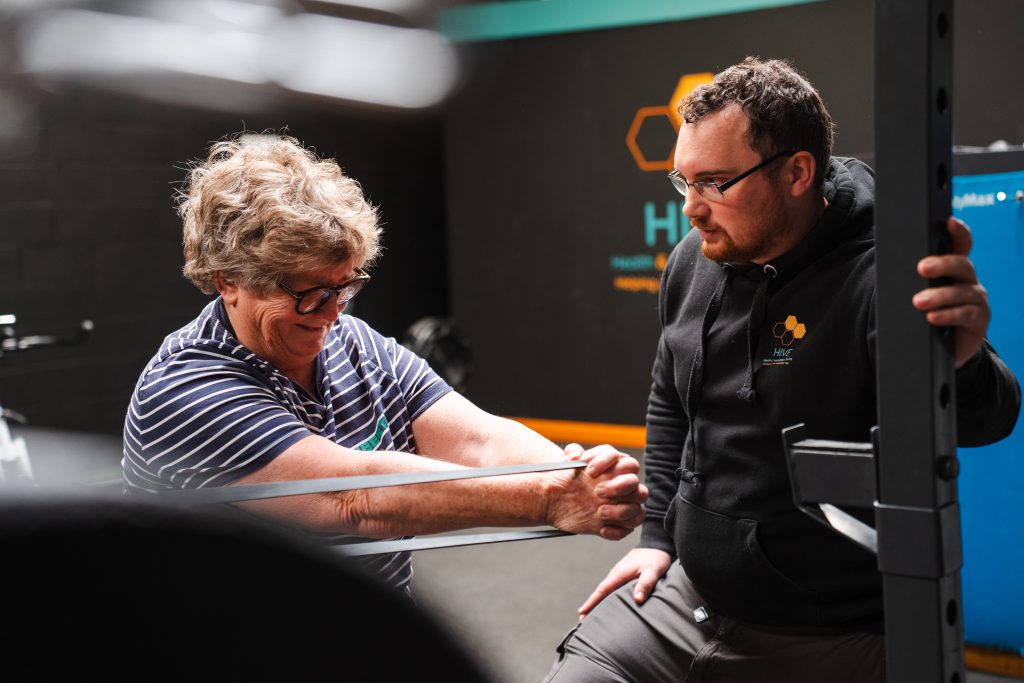
At The Hive, we start with where you are now.
We look at what you’re comfortable doing, what you’re finding difficult and what you’d like to return to.
Your exercises can then be tailored and progressively developed.
You might begin with relatively simple movements before moving towards more challenging strength exercises.
Eventually, rehabilitation can start to look less like “rehab” and more like normal exercise.
And that’s a good thing.
Because the goal isn’t to spend the rest of your life rehabilitating an injury.
The goal is to get back to living.
From Rehabilitation to Personal Training
One of the most difficult points in recovery can be what happens when formal rehabilitation ends.
You’re better – but perhaps not quite confident enough to walk into a conventional gym and work everything out yourself.
That’s one of the reasons The Hive brings rehabilitation and fitness together.
When you’re ready, you can progress from Exercise & Injury Rehabilitation into Personal Training & Fitness.
You already know the environment.
We already understand your journey.
And instead of rehabilitation having an abrupt finish line, the focus can gradually change from:
Recovering from injury → rebuilding strength → getting fitter → staying active.
Exercise & Injury Rehabilitation in Bideford
The Hive Health & Well-Being Centre provides exercise and injury rehabilitation in Bideford for people from across North Devon.
Whether you’re returning after a recent injury, have struggled to get back to exercise or simply don’t trust your body the way you did before, we’ll help you find an appropriate starting point.
You don’t have to go from injured to fully fit overnight.
Start where you are. Build from there.
Explore Exercise & Injury Rehabilitation